
From the first olive harvests thousands of years ago to our family’s 350 ancient olive trees in Portugal, discover the fascinating history behind one of the world’s oldest foods.
Have you ever wondered where olive oil originally came from?
When you pour a little olive oil over your salad, dip fresh bread into it, or use it for cooking, you’re enjoying something that humans have valued for thousands of years.
Long before supermarkets, modern agriculture, or even the Roman Empire, people were already harvesting olives and discovering ways to extract their precious oil.
The history of olive oil goes back at least 6,500 years, with some archaeological evidence suggesting production began around 7,000 years ago in the eastern Mediterranean.
But for our family, this history isn’t something we only read about in books.
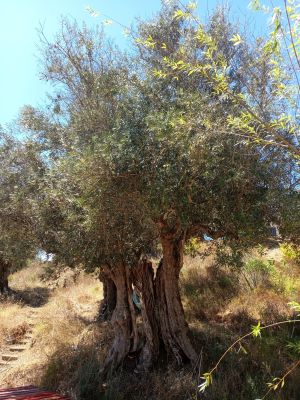
A few years ago, we left our 9-to-5 lives in Austria and moved to a five-hectare property in Portugal’s Alentejo region. Waiting for us were approximately 350 olive trees, some so old that an elderly Portuguese neighbour estimated their age at around 800 years.
We didn’t know that when we bought the land.
Today, these trees have completely changed the way we see nature, food, and our place in the world.
And their story connects beautifully with the ancient history of olive oil.
Where Did Olive Oil Originally Come From?
Olive oil originated in the Mediterranean region, with some of the earliest evidence of its production coming from the eastern Mediterranean, particularly the area known as the Levant.
This region includes parts of present-day Israel, Palestine, Lebanon, Syria, and surrounding territories.
Wild olive trees grew in the Mediterranean long before humans began cultivating them.
At some point, people discovered that the small, bitter fruits contained something incredibly useful: oil.
Unlike many other plants, olives contain substantial amounts of oil within their flesh.
By crushing the fruit and separating the oil from the water and solid material, early communities discovered a product that could be used for food, lighting, and many other purposes.
What began as a local resource eventually became one of the most important agricultural products in Mediterranean history.
When Was Olive Oil First Made?
The earliest known evidence of olive oil production dates back approximately 6,500 to 7,000 years.
Archaeologists investigating ancient settlements along the Carmel coast of present-day Israel discovered thousands of crushed olive stones and remains associated with early oil extraction.
These findings suggest that people were already processing olives for oil during the Neolithic and Chalcolithic periods.
Interestingly, research also suggests that olive oil production may have developed before the large-scale preparation of table olives.
In other words, humans may have learned to extract oil from olives before they developed the methods needed to make the bitter fruits pleasant to eat.
Imagine those first communities experimenting with crushed olives, discovering the rich liquid they contained, and gradually improving their methods.
They could hardly have imagined that thousands of years later, families across the world would still be enjoying the same product.
How Did Olive Oil Spread Across the Mediterranean?
Olive cultivation gradually spread from the eastern Mediterranean through trade, migration, and the exchange of agricultural knowledge.
Several ancient civilisations played important roles.
The Phoenicians: Traders Who Helped Spread Olive Cultivation
The Phoenicians were skilled sailors and merchants who established trading networks throughout the Mediterranean.
Through these networks, olive trees, olive oil, and knowledge about cultivation travelled westward.
Olive cultivation reached many Mediterranean coastal regions, including parts of the Iberian Peninsula.
The olive tree was particularly well suited to the Mediterranean climate, with its hot, dry summers and relatively mild winters.
Ancient Greece: The Olive Tree as a Symbol
In ancient Greece, the olive tree became much more than an agricultural crop.
It represented peace, prosperity, wisdom, and endurance.
Olive oil was used in cooking, religious ceremonies, body care, and athletic traditions.
The olive tree was so important that it became closely associated with Athena, the goddess of wisdom.
Even today, olive branches remain powerful symbols of peace.
The Romans: Olive Oil Becomes an Everyday Essential
The Romans helped expand olive cultivation and olive oil trade across their territories.
Olive oil became an important part of Roman life.
It was used for food, lamps, body care, and various practical purposes.
Roman farms produced oil, and extensive trading networks transported it between regions.
Large ceramic containers called amphorae were used to store and transport many goods, including olive oil.
As Roman influence expanded across the Iberian Peninsula, olive cultivation became increasingly important in the region that is now Portugal.
And this brings us a little closer to our own farm.
How Did Olive Oil Come to Portugal?
Olive cultivation reached the Iberian Peninsula long before modern Portugal existed.
Phoenician trading networks helped introduce and spread olive cultivation, while the Romans significantly expanded production.
During the Roman period, much of present-day Portugal belonged to the province of Lusitania.
Agriculture was an important part of the region’s economy, and olives were among the crops cultivated in suitable areas.
Later, during centuries of Islamic rule in parts of the Iberian Peninsula, olive cultivation continued to develop.
The influence of Arabic can still be heard in the Portuguese language today.
The Portuguese word for olive oil is azeite, and the word for olive is azeitona. Both have Arabic origins.
We find that fascinating.
Every time someone in Portugal asks for azeite, they’re using a word that carries centuries of cultural history.
A Roman Road Near Our Olive Farm
Not far from our property in Alentejo, there is an old Roman road.
Sometimes, while walking through our olive grove, we think about the people who travelled through this landscape so many centuries ago.
Roman soldiers, traders, farmers, and travellers once moved through this part of Portugal.
Did some of them pass through the hills around our property?
Did they rest beneath olive trees growing in the same landscape?
We will probably never know.
Our oldest trees are believed to be around 800 years old, which means they would have started growing long after the Roman period.
But perhaps there were other olive trees here before them.
Perhaps the land was already producing olives centuries before the trees we care for today began growing.
We can’t prove that, of course.
Still, having an ancient Roman road nearby makes the history of this landscape feel wonderfully close.
Our 350 Olive Trees: Living History in Portugal
When we bought our property in Alentejo, we knew there were olive trees.
What we didn’t know was just how old some of them might be.
One day, an elderly Portuguese neighbour told us that some of our trees could be approximately 800 years old.
He also told us about a harvest when the land had produced an incredible five tonnes of olives.
We have never had the trees professionally dated, so their age remains an estimate.
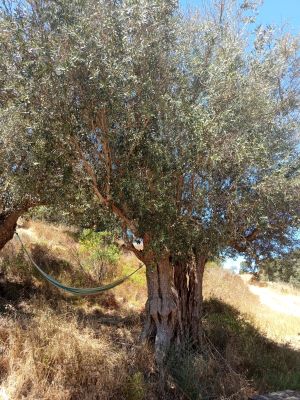
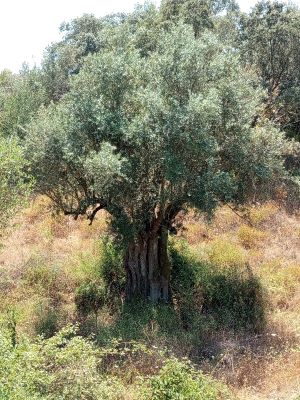
But looking at their enormous, twisted trunks, their shapes, and the way they’ve adapted to the landscape, it’s easy to understand why he believed they were so old.
What amazes our visitors most isn’t simply the size of these trees.
It’s the fact that they are still producing olives.
After hundreds of years of sun, wind, rain, drought, and changing seasons, they continue to give us fruit.
Every single year.
We Don’t Own the Trees. We’re Their Caretakers.
Living among these ancient trees has changed our perspective.
When you move onto a piece of land with trees that may have been growing for centuries, you begin to realise something.
You are only there for a short time.
The trees were here long before you arrived.
And hopefully, they’ll still be here long after you’re gone.
We don’t really see ourselves as owners of these trees.
We see ourselves as caretakers.
Visitors.
Guests.
Our responsibility is to look after them as well as we can, enjoy the time we’re given with them, and leave them healthy for the generations that follow.
It’s a different way of looking at land ownership.
And it’s one of the most valuable things our new life in Portugal has taught us.
How Olive Oil Was Traditionally Harvested
For thousands of years, olive harvesting was primarily done by hand or with simple tools.
Farmers collected the olives, brought them to a mill, and crushed them to extract the oil.
Methods changed over the centuries, but the basic principle remained the same.
Harvest the fruit.
Crush the olives.
Separate the oil.
Today, modern machinery makes it possible to harvest and process enormous quantities of olives.
In many commercial plantations, trees are planted in straight rows, carefully spaced to allow mechanical harvesting.
We see these plantations around us in Alentejo.
Young trees, perfectly aligned, planted for efficient production.
It’s a completely different world from our olive grove.
Why We Still Harvest Our Olives by Hand
Our trees don’t stand in neat rows.
They’re scattered across hills, slopes, and uneven ground.
Some stand close together.
Others grow alone.
Some are easy to reach, while others make harvesting a real challenge.
But we wouldn’t want it any other way.
We harvest our olives by hand because we want to treat our trees as gently as possible.
When we hear about fully grown olive trees being shaken by large harvesting machines, we can’t help feeling uncomfortable.
We understand why commercial producers use machinery. It can make harvesting much faster and more economical, and well-managed mechanical harvesting doesn’t necessarily harm trees.
But for our ancient trees, we prefer a different approach.
We work slowly and carefully.
Sometimes, while harvesting, we discover birds’ nests hidden among the branches.
That’s when we become even more aware that these trees aren’t simply agricultural equipment.
They’re living habitats.
We try to work around the nests and avoid disturbing the wildlife that shares our land.
And then there is one feeling that never gets old.
Holding a handful of freshly harvested olives and letting them slowly run through your fingers.
It’s difficult to describe.
The weight of the fruit.
The different colours.
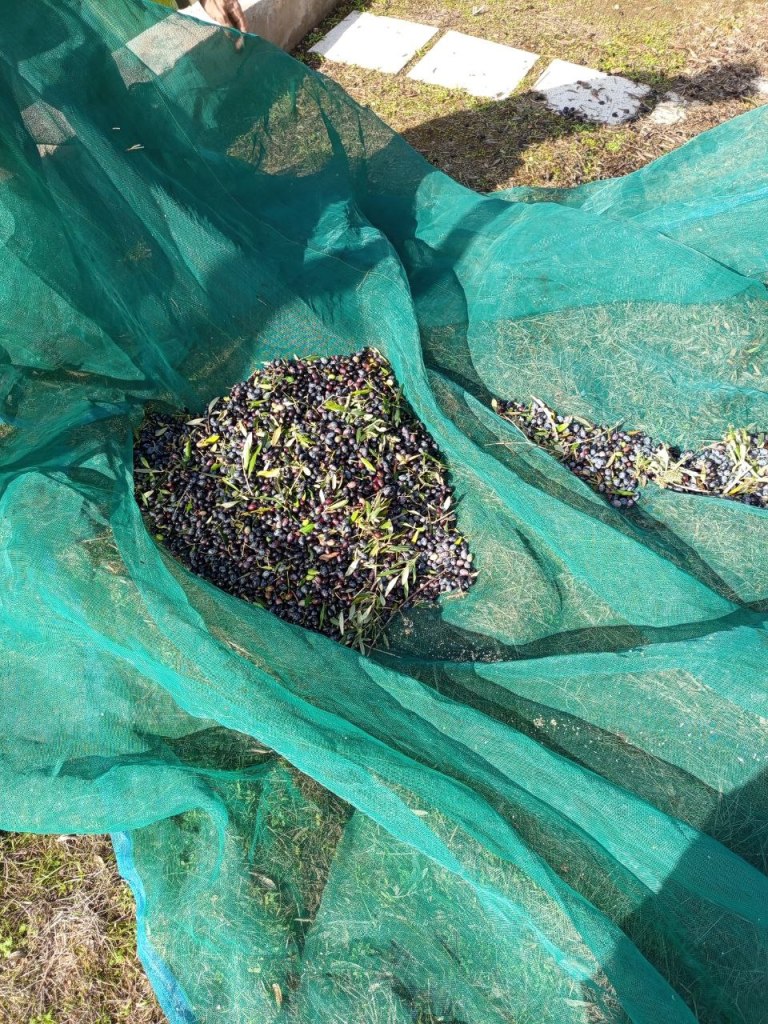
The knowledge that these olives grew on trees that have survived for generations.
And the gratitude that we are allowed to harvest them.
For us, that’s what olive oil production is really about.
From Ancient Olive Presses to Our Family’s Olive Oil
Although we prefer traditional harvesting, we also appreciate the advantages of modern olive oil production.
After collecting our olives, we take them to be pressed on the same day.
This helps preserve freshness and reduces the time the harvested fruit spends waiting before processing.
Our olive trees grow naturally without irrigation or artificial fertilisers.
We don’t try to force them to produce the maximum possible quantity.
Instead, we harvest what nature gives us.
Some years are more productive than others.
That’s simply part of working with nature.
Today, our small family operation produces and sells around 500 litres of virgin olive oil annually.
It might not sound like much compared with industrial producers.
But every litre represents time spent among our trees, careful harvesting, and a connection to the land that we deeply appreciate.
Why Olive Trees Can Live for Hundreds of Years
One of the most fascinating things about olive trees is their extraordinary longevity.
Olive trees are remarkably resilient.
They can survive in dry environments, adapt to difficult growing conditions, and continue producing new growth even as parts of their trunks age.
Their roots and regenerative ability help them survive challenges that would be difficult for many other fruit trees.
Some ancient olive trees around the Mediterranean are believed to be more than a thousand years old, although accurately determining the age of very old trees can be difficult.
Their trunks often become hollow or irregular over time, making conventional age measurements challenging.
That’s why we treat the estimated age of our own oldest trees with respect rather than certainty.
Whether they’re 500, 800, or another age entirely, their presence is extraordinary to us.
Is Olive Oil Still Made the Same Way Today?
The basic idea has remained remarkably similar.
Olives are harvested and mechanically processed to release their oil.
But the methods have changed enormously.
Ancient producers used stone crushing equipment, presses, and settling methods.
Modern mills use specialised crushing, mixing, and separation equipment that allows much more controlled processing.
These improvements can help producers maintain hygiene, process olives quickly, and preserve quality.
But technology doesn’t replace the importance of good fruit.
An excellent olive oil still begins with healthy olives, careful harvesting, and proper handling.
That’s why we believe the relationship between farmer and tree remains so important.
From Our Trees to Your Table
One of the reasons we started sharing our olive oil with customers in Austria and Germany was that we wanted people to experience something different.
Not simply another bottle from a supermarket shelf.
But olive oil with a story.
Olive oil from trees they can actually see.
Trees that grow on a real family farm in Portugal.
Trees that we harvest ourselves.
That’s also how our olive tree sponsorships began.
Sponsor Your Own Ancient Olive Tree in Portugal
Through Equilibrio, you can sponsor one of our olive trees and become part of its story.
Your sponsorship includes:
- A photograph of your sponsored olive tree
- The opportunity to give your tree a personal name
- Six litres of our virgin olive oil from the annual harvest
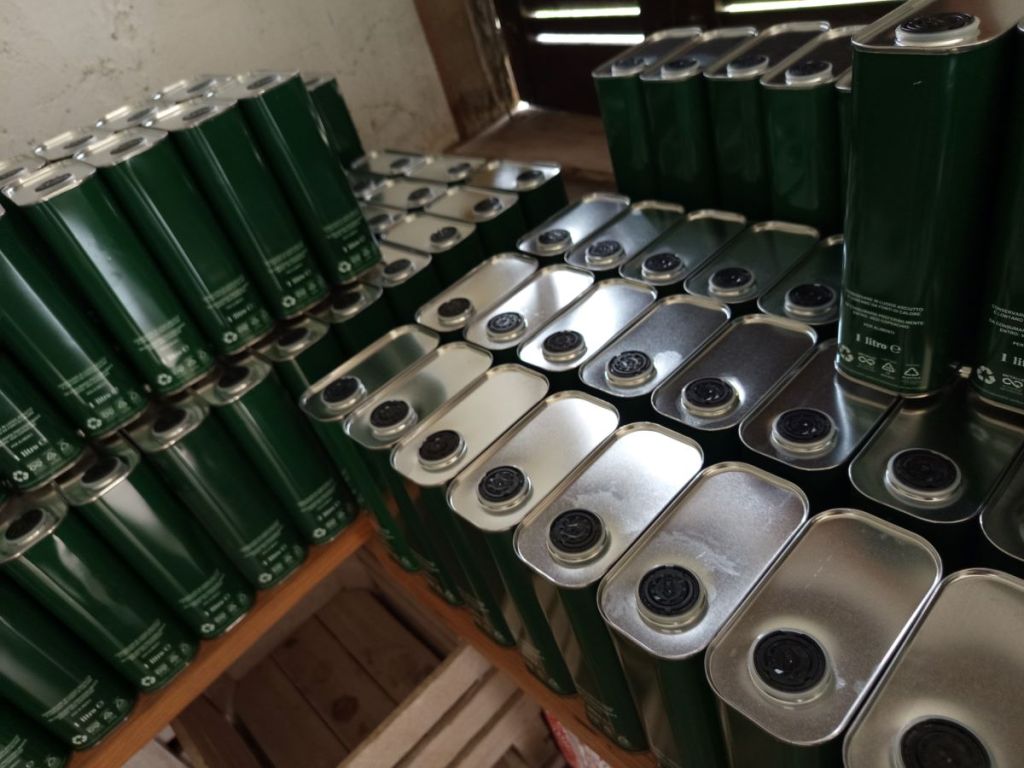
- Delivery in six separate one-litre metal tins to help preserve freshness
Our olive oil is harvested once a year, and we organise our annual shipments primarily for customers in Austria and Germany but also other countries in Europe.
An olive tree sponsorship also makes a meaningful gift for birthdays, weddings, anniversaries, Christmas, or simply for someone who appreciates nature and good food.
It’s a personal connection to a tradition that began thousands of years ago.
Discover our olive tree sponsorships at www.equilibrio.com.pt.
Frequently Asked Questions About the Origin of Olive Oil
Where was olive oil first invented?
The earliest archaeological evidence of olive oil production comes from the eastern Mediterranean, particularly the Levant. Sites along the Carmel coast of present-day Israel provide evidence of very early olive processing.
How old is olive oil?
Olive oil production is at least 6,500 years old, and some archaeological evidence points to approximately 7,000 years ago. The exact date of its first production remains unknown.
Did olive oil originate in Greece or Italy?
Neither Greece nor Italy is generally considered the original birthplace of olive oil production. Its earliest known roots lie farther east in the Mediterranean. However, both ancient Greek and Roman civilisations played major roles in developing and spreading olive oil culture.
Did the Romans bring olive oil to Portugal?
Olive cultivation reached the Iberian Peninsula before Roman rule, but the Romans helped expand olive farming and oil production across the region, including parts of present-day Portugal.
What is the oldest olive tree in the world?
Several ancient olive trees around the Mediterranean are claimed to be thousands of years old. However, their exact ages are often difficult to verify, and there is no universally agreed oldest living olive tree.
Where does olive oil come from today?
Olive oil is produced in many countries, particularly around the Mediterranean. Spain, Italy, Greece, Portugal, Tunisia, and Türkiye are among the well-known olive-producing countries.
Olive cultivation has also spread to other regions with suitable climates, including California, Australia, Chile, and South Africa.
Is traditional olive oil better than industrially produced olive oil?
Traditional production can offer a strong connection to the land and careful harvesting practices, but the quality of olive oil depends on more than whether harvesting is done by hand or machine.
Olive quality, harvesting conditions, processing, freshness, and storage all play important roles.
For our family, hand harvesting is a choice rooted in how we want to care for our ancient trees.
Final Thoughts: Thousands of Years of History in Every Drop
So, where does olive oil come from?
Its story begins thousands of years ago in the eastern Mediterranean, where people first learned to cultivate olive trees and extract oil from their fruit.
From there, olive oil travelled through ancient trading networks, Greek civilisation, the Roman Empire, and eventually became an essential part of Portuguese agricultural life.
Today, that history continues in countless olive groves around the Mediterranean.
Including ours.
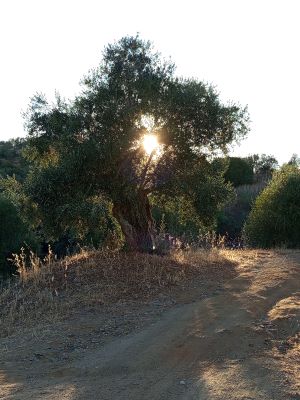
Sometimes, when we stand beneath one of our oldest trees, we think about how much the world has changed during its lifetime.
Generations have come and gone.
Borders have changed.
Empires have risen and disappeared.
Yet the olive trees continue growing.
And every autumn, they offer their fruit again.
We are simply fortunate enough to be here for a small part of their story.
If you would like to become part of that story too, we’d love to introduce you to one of our olive trees.
Visit Sponsorship to discover our family farm, our olive oil, and our olive tree sponsorships.
From our family and our ancient olive trees in Alentejo, Portugal.


